Search for breathing exercises and you will drown in them. Dozens of named techniques, most claiming a different benefit, several contradicting each other. This page cuts it down to six that are genuinely worth knowing, what each one is for, and how to do it without any equipment.
First, the one principle underneath almost all of them
Make the out-breath longer than the in-breath, and breathe lower in the body rather than higher. Nearly every technique below is a variation on those two ideas dressed in different counting. If you remember nothing else, remember that.
1. Diaphragmatic (belly) breathing
One hand on the stomach, one on the chest. Breathe so the lower hand rises and the upper one barely moves. Most adults have drifted into shallow upper-chest breathing without ever deciding to, and the diaphragm responds to use like any other muscle.
Use it for: the foundation. Learn this one before the others. Five minutes a day is the standard suggestion.
2. Pursed-lip breathing
In through the nose for a count of two, out through lightly pursed lips — as though cooling a spoonful of soup — for a count of four. The gentle back-pressure helps keep smaller airways from collapsing as you exhale.
Use it for: breathlessness during exertion. This is routinely taught in pulmonary rehabilitation, and people often describe it as the most immediately useful thing they were shown.
3. Extended exhale (4–6)
In through the nose for four, out for six. No holds, no complexity. It is the simplest possible expression of the principle above and needs no learning curve at all.
Use it for: winding down, or any moment you want something steadying that nobody around you will notice.
4. Box breathing (4–4–4–4)
Four counts in, four holding, four out, four holding. Borrowed from military and emergency-services training, where the counting itself does useful work by giving the mind a task.
Use it for: focus before something demanding. Skip the holds if they feel strained.
5. Coherent breathing (about five breaths a minute)
Six seconds in, six seconds out, repeated for several minutes. The slow, even rhythm is the entire point — there is nothing to hold and nothing to count beyond the six.
Use it for: longer sessions of ten minutes or more, where you want a pace you can sustain without concentrating hard.
6. Alternate-nostril breathing (nadi shodhana)
A yogic technique: close the right nostril with the thumb, breathe in through the left; close the left, breathe out through the right; in through the right, out through the left. That is one round.
Use it for: a more structured practice with a clear beginning and end. The ritual of it is part of why people keep it up.
Common mistakes
- Forcing it. If you finish feeling light-headed or strained, you are pushing too hard. These should feel easier than normal breathing, not harder.
- Holding too long. Long breath-holds belong to advanced practice with a teacher, not to a beginner on a kitchen chair.
- Doing it only when stressed. The practice works better when it is routine. Starting it only in difficult moments means learning a new skill at the worst possible time.
- Expecting it to fix a symptom. It will not, and that matters — see below.
When a technique is the wrong answer
Breathlessness during ordinary activity — the walk to the shops, carrying groceries, one flight of stairs — is not something to practise your way out of. Nor is a cough lasting beyond three weeks, blood in your mucus, wheezing or chest pain. Those belong with a doctor, promptly. Breathing exercises are a wellness practice for people whose breathing is basically fine and who would like to use it more deliberately.
Where a supplement comes into it
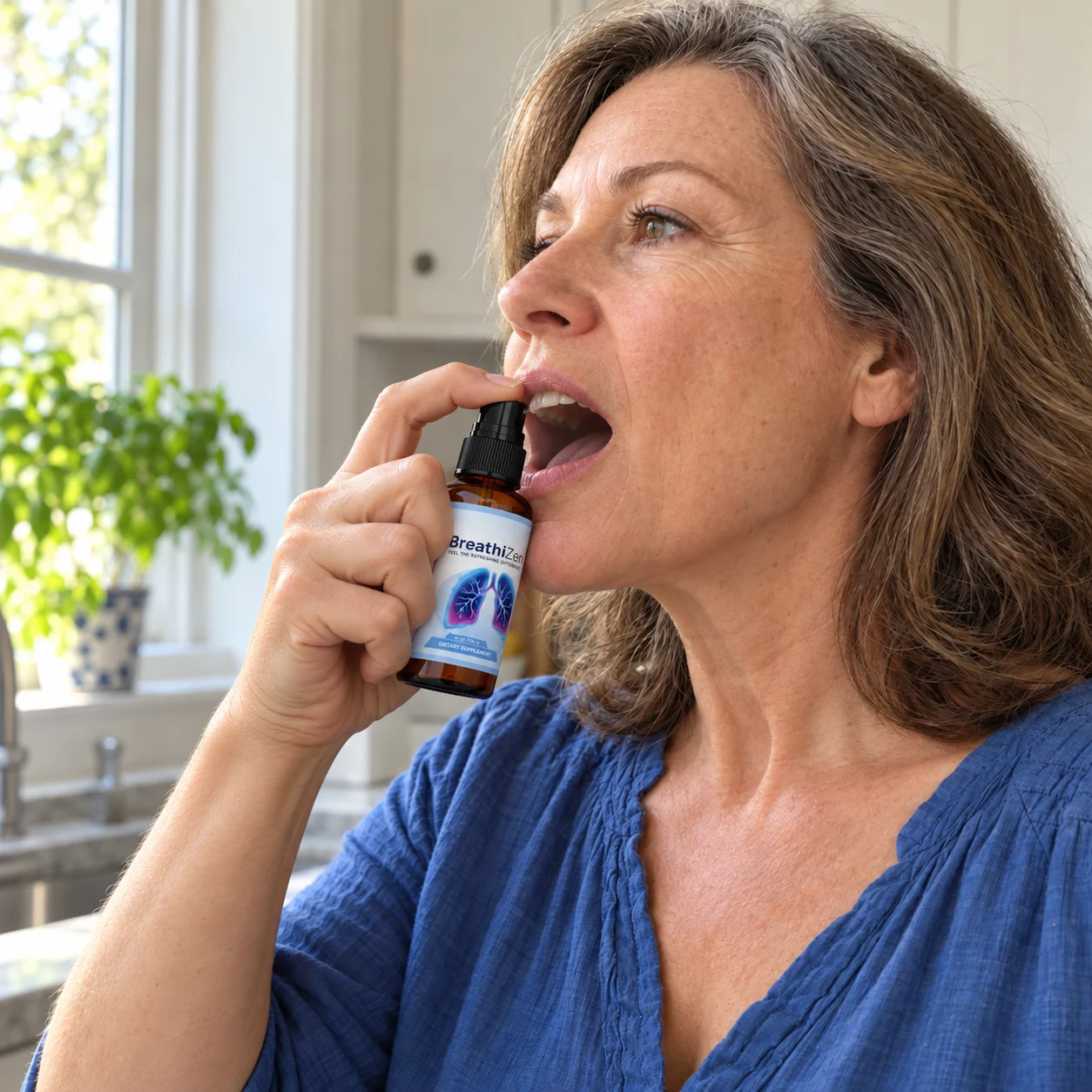
It doesn't, really — not for the practice itself, which costs nothing and needs nothing. BreathiZen® is a separate thing: a daily botanical routine of mullein, ginger and lemon that some people run alongside a breathing practice. Neither depends on the other, and we would rather say that plainly than imply a connection that isn't there.
The Practice Is Free. The Botanical Half Isn't.
If you want it alongside, packages start at $49 a bottle with a 60-day guarantee.
See Package PricingThese statements have not been evaluated by the Food and Drug Administration. BreathiZen® is a dietary supplement and is not intended to diagnose, treat, cure or prevent any disease. Breathing techniques described here are general wellness practices, not medical treatment. Prices, shipping and guarantee terms are set by the official retailer and confirmed at checkout. Speak to your doctor before starting any supplement.
← Back to home