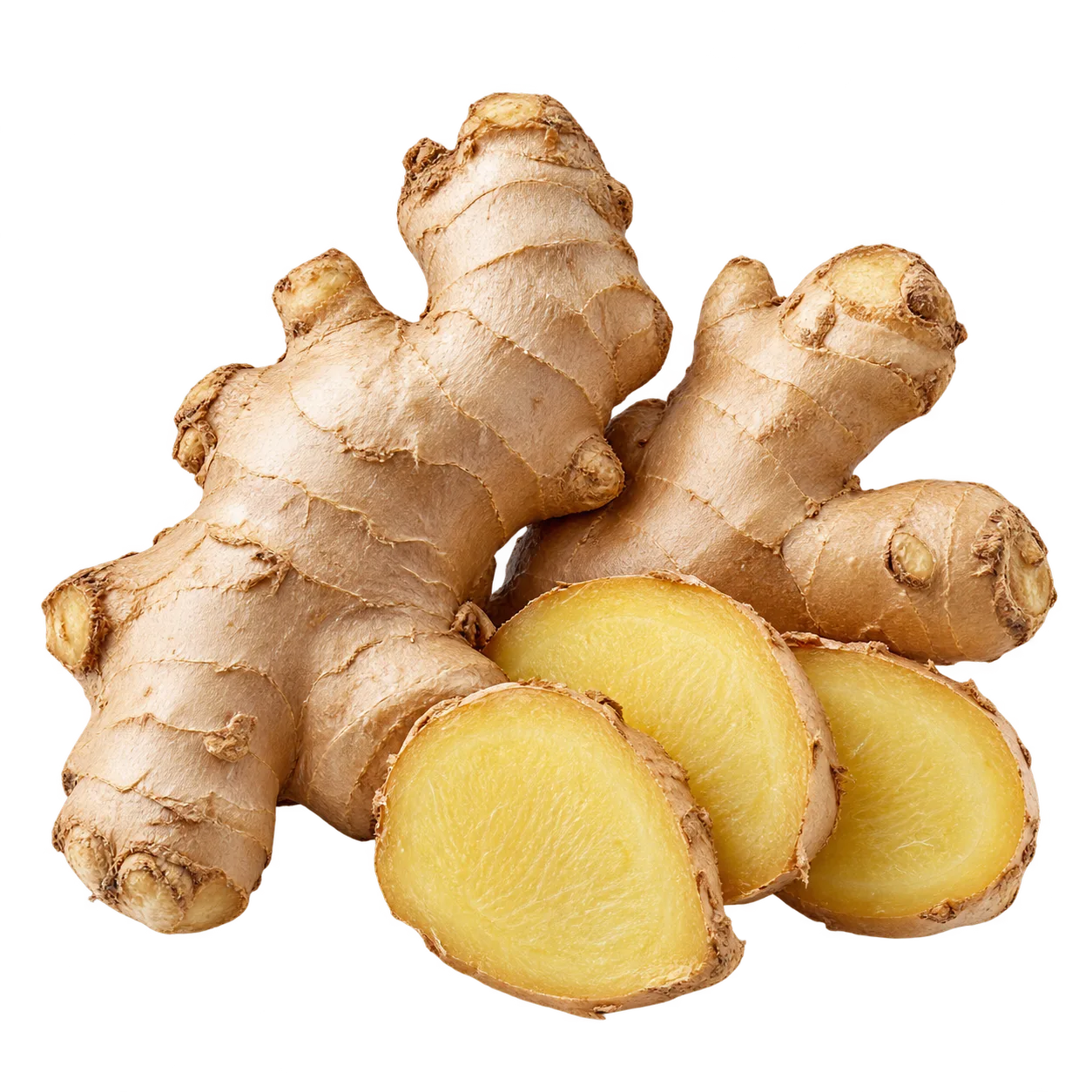
Ginger appears in respiratory supplements constantly, usually with a nod to "clinical research." There is real research. It is also widely misrepresented, so here is the whole thing in plain terms.
The experiment
A team at Columbia University set out to answer something narrow: does ginger act directly on airway tissue? They took small strips of human airway smooth muscle, used a chemical to make those strips contract — roughly what happens when airways tighten — and then exposed them to food-grade ginger.
The muscle relaxed. More ginger, more relaxation.
Narrowing it down
Ginger contains a great many compounds, so the team tested them individually. Three were active: 6-gingerol, 8-gingerol and 6-shogaol. A fourth, 10-gingerol, did nothing whatsoever — and that absence matters, because it means the effect belongs to specific named molecules rather than being a vague property of the plant.
Follow-up work found the active compounds appear to operate by inhibiting two enzymes involved in keeping airway muscle contracted. The same work found ginger compounds strengthened the effect of a standard airway medication rather than interfering with it.
Sources: Townsend et al., Am J Respir Cell Mol Biol 2013 · Townsend et al., 2014
Now the part that gets left out
All of this happened to tissue in a laboratory dish. Those muscle strips never had to survive a stomach, cross a gut wall, or pass through a liver. They sat in a bath of purified compound at a concentration the researchers selected.
Swallow ginger and your body dismantles those compounds quickly. The same research group has published on exactly this gap. To date, no trial in people has shown that ginger taken by mouth changes anybody's breathing.
Where ginger's evidence is actually strongest
Nausea, and not by a narrow margin. Travel sickness, the nausea of early pregnancy and post-operative nausea have each been studied in people more than once, with results that broadly agree. There is respectable support too for ginger acting against inflammation generally.
Neither of those is a breathing claim, and it would be dishonest to present them as adjacent to one.
Safety worth knowing
Because ginger has an effect on clotting, anyone taking warfarin or a comparable blood thinner should clear a concentrated ginger supplement with their doctor first. The same conversation is worth having if you are on medication for diabetes or blood pressure, or have surgery scheduled. At ordinary doses, the complaint that comes up most is mild heartburn.
What to do with this
Treat ginger as a well-chosen ingredient with an interesting preclinical story, not as the reason a product will work for you. And treat any seller who tells you the Columbia study proves their formula works as having answered a different question than the one you asked.
Three Botanicals, Once a Day
Packages from $49 a bottle, every one with the same 60-day guarantee.
See Package PricingThese statements have not been evaluated by the Food and Drug Administration. BreathiZen® is a dietary supplement and is not intended to diagnose, treat, cure or prevent any disease. Breathing techniques described here are general wellness practices, not medical treatment. Prices, shipping and guarantee terms are set by the official retailer and confirmed at checkout. Speak to your doctor before starting any supplement.
← Back to all articles